Short Bhutan Tour Package - 3 Night 4 Days

Short Bhutan Tour Package - 3 Night 4 Days

33,120 metersBhutan
Duration
4 Days
Max altitude
3,120 meters
Difficulty
moderate
Group size
1-6
Best season
Autumn and Spring

The 3 Nights 4 Days Bhutan Tour begins with a one-hour flight from Kathmandu along the Himalayas into Paro. Over four days, you cover Thimphu’s main landmarks, hike up to Tiger’s Nest Monastery, and fly back to Kathmandu on the last day. One night is in Thimphu and two are in Paro.

Overview of the 4 Days Bhutan Tour

The 3 Nights 4 Days Bhutan Tour is a guided short trip from Kathmandu that flies to Paro, spends one night in Thimphu and two in Paro, and climbs to Tiger’s Nest Monastery at 3,120 m (10,236 ft). The flight takes about 1 hour each way, and the Paro–Thimphu drive takes 1 to 1.5 hours.

The 3 Nights 4 Days Bhutan Tour works best for travellers who have a few spare days around a Nepal trip and don’t want to give up a week for Bhutan. It also suits first-timers who want a clear taste of the country, families with school-age children and older travellers who like culture more than long treks. You need moderate fitness for one day, the Tiger’s Nest hike, and nothing else on the route is strenuous. Be aware of what this route leaves out: it covers Paro and Thimphu.

The two-night stay in Paro is the quiet strength of this short Bhutan tour from Kathmandu. You reach Paro on day two, sleep there and tackle Tiger’s Nest on day three with a full night behind you, instead of squeezing the hike in after a flight. The first night in Thimphu, at around 2,330 m, also gives your body a gentle start before the climb.

Days follow an easy rhythm: a main sight in the morning, a second after lunch and time to rest at the hotel. The exception is day three, when the Tiger’s Nest hike takes most of the day. Your licensed Bhutanese guide travels with you throughout, explains what you’re looking at, and walks you through each site, so you can focus on the views.

Bhutan allows tourists only on pre-arranged, guided trips, so your guide, driver and visa all come through a licensed operator. Nobel Holidays handles that paperwork from Kathmandu. On a clear day, the flight passes Everest, known in Tibetan as Chomolungma, and our journal explains the meaning and history of Chomolungma. Learn more about the team on our about page.


Key facts at a glance

Tour RegionBhutan
Tour TypeCultural and Sightseeing Tour
Starting PointKathmandu, Nepal
Ending PointKathmandu, Nepal
Main HighlightsTiger’s Nest Monastery, Himalayan scenery, and Thimphu sightseeing
Cultural HighlightsBuddhist monasteries, Bhutanese traditions, and local markets
Main ActivitiesCity sightseeing, cultural visits, and hiking to Tiger’s Nest
Hiking DurationApproximately 5–6 hours for the Tiger’s Nest hike

Trip highlights

Watch Everest, Makalu and Kanchenjunga rise above the clouds from the plane window

Land at Paro, Bhutan’s only international airport, in a narrow valley ringed by forested ridges


Drive the river-valley road between Paro and Thimphu, about 1 to 1.5 hours each way


Stand at Buddha Point (Kuensel Phodrang) beside the giant Buddha with Thimphu Valley below

Walk clockwise around the National Memorial Chorten with local worshippers


See Tashichho Dzong, the fortress that houses government offices and monastic facilities


Explore the Folk Heritage Museum and Textile Museum for a look at Bhutanese weaving and rural life


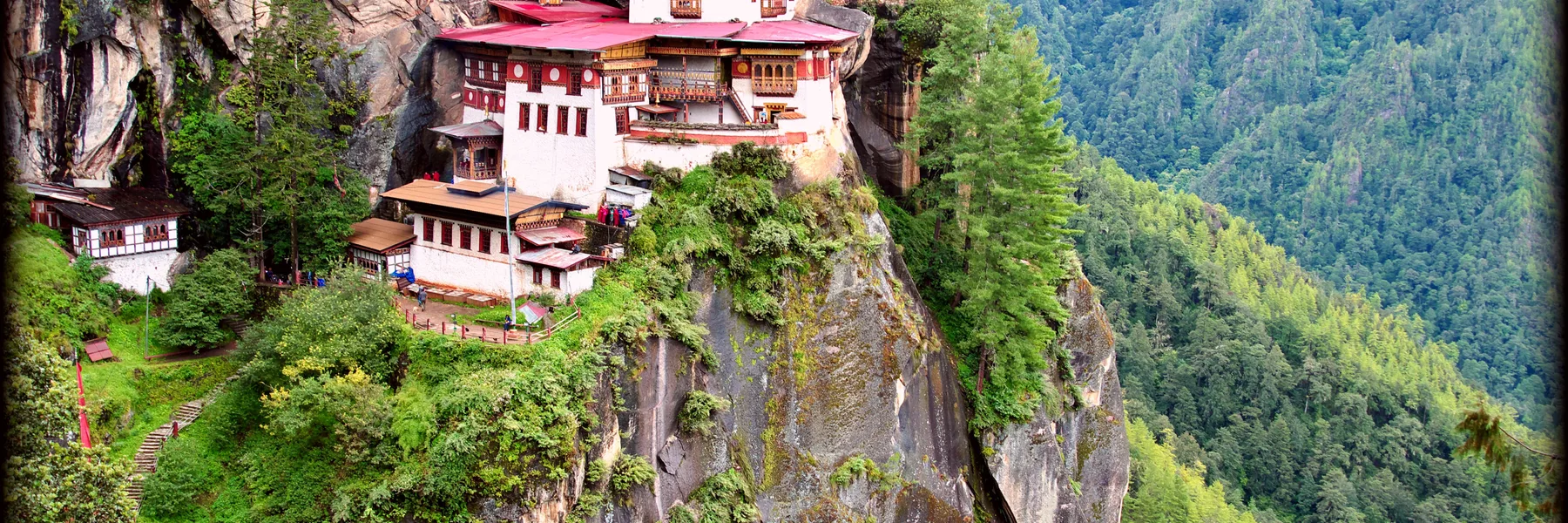
Hike to Tiger’s Nest Monastery, clinging to a cliff at about 3,120 m


Climb to the National Museum (Ta Dzong) and wander Paro’s local markets


Day-by-day itinerary

Day
01
Fly from Kathmandu to Paro and Drive to Thimphu+

Your flight leaves Tribhuvan International Airport at a time set by that day’s schedule. The Kathmandu to Paro flight takes about 1 hour. Keep your visa clearance letter within reach. Out of the window, the Himalayan range rolls past, and then the plane drops into the narrow Paro valley. Landing here takes specially trained pilots, and the approach between the ridges is part of the show.

Your guide meets you outside the terminal at Paro International Airport after immigration. From there, the drive to Thimphu takes about 1 to 1.5 hours along a road that follows the river valley. Thimphu, Bhutan’s capital, is at about 2,330 m, so take the first evening easy.

Bhutan has no traffic lights, and in Thimphu’s centre you’ll see police direct cars by hand. Prayer flags flutter on hillsides along the road, and farmhouses with painted wooden windows appear between the fields.

Check in at your hotel, unpack and rest. The first day is deliberately light, which helps you adjust to the altitude before the hike on day three.


Day
02
Thimphu Sightseeing and Drive Back to Paro+

After breakfast, start at Buddha Point (Kuensel Phodrang), where a giant bronze Buddha, about 51.5 m (169 ft) tall, looks over Thimphu Valley. Inside, the statue holds around 125,000 smaller Buddha figures. Morning light is usually clearest, so the panorama is worth the early stop.

Next is the National Memorial Chorten, a white stupa completed in 1974 in memory of Bhutan’s Third King. Locals walk clockwise around it with prayer beads and wheels, and you’re welcome to join them. Keep your voice low and follow your guide’s lead.

Then comes Tashichho Dzong, the large fortress-monastery that holds government offices alongside monastic facilities. Visiting hours vary, so your guide fits it into the day when it is open to visitors.

The Folk Heritage Museum and the Textile Museum round out the sightseeing. The first shows how rural Bhutanese families lived, and the second explains the weaving traditions behind the patterned fabrics you see people wearing across Thimphu.

After lunch, drive back to Paro, again about 1 to 1.5 hours, and check in for your overnight stay.


Day
03
Hike to Tiger’s Nest Monastery and Explore Paro+

Start early, because the climb is the main event of the trip. Tiger’s Nest Monastery (Taktsang Lhakhang) clings to a cliff at about 3,120 m, roughly 900 m above the Paro Valley floor. The uphill hike takes 2 to 3 hours depending on your pace, and the full outing, including time at the monastery and the walk down, runs about 5 to 6 hours.

The path climbs through pine forest hung with prayer flags. About halfway, near 2,950 m, a small cafeteria makes a good place to rest and look up at the monastery. The last climb is steeper and includes stone steps, so keep a slow, steady pace. Look back and the Paro Valley opens beneath you, patchworked with fields and farmhouses. Your guide sets the pace and knows the best rest spots, so you never need to race faster hikers.

Tradition says Guru Padmasambhava meditated in a cave here, and a temple was built around it in 1692. A fire damaged the complex in 1998, and it has since been restored.

After the walk down, return to Paro town and visit the National Museum (Ta Dzong), a round watchtower built in 1649 above Rinpung Dzong. It closed after the 2011 earthquake, reopened after a long restoration, and now displays Bhutanese art and history. Finish with a walk through Paro’s local markets, where handicrafts and everyday goods give a feel for the town’s traditional atmosphere.


Good to know before you go

Spring (March to May) and autumn (September to November) give the clearest skies and the most comfortable weather for this route. Both seasons also host tshechu festivals with masked dances, Paro’s in spring and Thimphu’s in autumn, though dates follow the Bhutanese lunar calendar and shift each year.

October and November overlap Nepal’s busiest holiday period, so read our Dashain and Tihar guide and book early. For a feel for mountain conditions, see how our guides read the weather.


Packing essentials

Clothing

T-shirts, comfortable trousers, long-sleeved shirts, light jacket, warm sweater, rain jacket, comfortable walking clothes, modest clothing for monasteries.

Footwear

Comfortable walking shoes, hiking shoes, extra socks.

Hiking Essentials

Small daypack, trekking poles (optional), reusable water bottle, lightweight snacks.

Sun Protection

Sunglasses, sunscreen, lip balm, sun hat, moisturizer.

Personal Essentials

Toothbrush, toothpaste, toiletries, quick-dry towel, hand sanitizer, tissues, wet wipes.

Health and Safety

Personal medication, basic first-aid kit, blister plasters, motion sickness medication if needed.


Travel Documents

Passport, Bhutan visa clearance documents, travel insurance, flight tickets, hotel booking details, cash, credit or debit card.

Electronics

Mobile phone, camera, power bank, charging cables, travel adapter.

Optional Items

Binoculars, small umbrella, notebook, reusable shopping bag.

Frequently asked

Is the 3 Nights 4 Days Bhutan Tour enough to see Bhutan?+
Yes, if you want Paro, Thimphu and Tiger’s Nest. You see the capital’s main landmarks, Paro’s museum and markets and the country’s most famous monastery. What you miss are Dochula Pass, Punakha Dzong and the central valleys. Those usually need a longer itinerary, so if Punakha is on your list, ask us about adding nights before you book.
Which days do flights run between Kathmandu and Paro?+
Two airlines, Drukair and Bhutan Airlines, fly the route, and schedules change by season, so flights do not always run daily. In winter 2025–26, one airline listed just four flights a week. Trip dates are built around flight days. Check availability before you commit to dates, and if you need a ticket, our flight ticketing page can help.
Which side of the plane gives the best Everest view?+
Sit on the left (A seats) when flying from Kathmandu to Paro, and on the right (F seats) on the way back. Everest, Makalu and Kanchenjunga can appear on clear days, but cloud sometimes hides them. Wings can block part of the view, so ask for a window seat at check-in.
What happens if the Paro flight is delayed or cancelled?+
Flights into Paro follow visual flight rules only, so low cloud or poor visibility can delay or cancel them. If that happens, our Nobel Holidays team will help you rearrange the plan, though a lost day cannot always be recovered. Avoid tight onward connections from Kathmandu, carry travel insurance and read the booking terms to see how changes are handled.
Can I ride a pony to Tiger’s Nest?+
Partly. Ponies or mules can usually be hired to carry riders from the trailhead to the cafeteria, about halfway. The rest of the path, including the steep steps near the top, is on foot. Rides are paid for locally, usually in cash, so tell your guide early if you want one and carry small notes.
Can I take my phone or camera inside Tiger’s Nest?+
No. Bags, phones and cameras go into lockers at the entrance, and photography is not allowed inside the temples. Your guide walks you through the process. You can photograph the monastery from the trail and viewpoints, where the classic shots come from. Always ask before photographing a person, especially a monk.
Is travel insurance compulsory for Bhutan?+
Bhutan dropped its insurance requirement for tourist visas in 2024, but cover is still strongly advised, so check the current rule with us before you travel. Healthcare is basic by international standards, and an evacuation is costly. Choose a policy that covers emergency evacuation and hiking to about 3,120 m, and save the policy number on your phone.
What currency should I carry in Bhutan?+
Carry some Bhutanese ngultrum (BTN). Indian rupees are widely accepted, and US dollars and other major currencies can be exchanged at banks and larger hotels in Thimphu and Paro. ATMs exist in Thimphu, but foreign cards do not always work, and many small shops and markets want cash. Bring small notes for Paro’s market stalls.
Can I get a SIM card or mobile data in Bhutan?+
Yes. Tourist SIM cards are sold at Paro airport and need your passport for registration. B-Mobile (Bhutan Telecom) usually has better coverage than TashiCell. An eSIM also works on the local networks, and 4G is generally good in Thimphu and Paro. Install the eSIM before you leave Kathmandu, since airport Wi-Fi can be limited, and download offline maps.
What is the Sustainable Development Fee, and who pays it?+
The Sustainable Development Fee (SDF) is a government charge on every night most international visitors spend in Bhutan. It is USD 100 per person per night through 31 August 2027, children aged 6 to 11 pay half, and under-6s pay nothing. The visa is a separate one-time USD 40. Indian citizens pay a lower rupee rate. Ask us how the fee appears in your booking.