Chomolungma: Meaning, History & Sacred Tibetan Connection
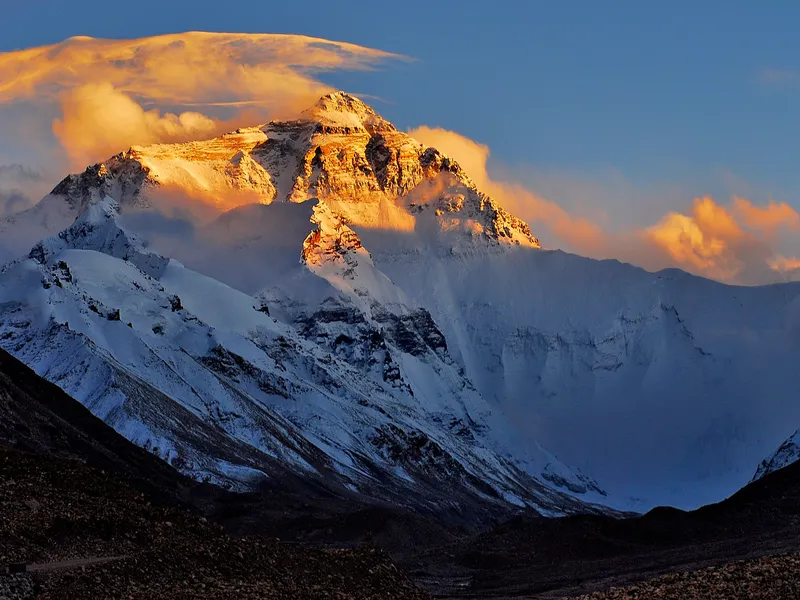
Discover the Tibetan name, the living goddess, and the true story behind the world's highest peak.
Most people know this mountain as Everest, a record to break and a summit to claim. Tibetans know it as Chomolungma, a living goddess and a sacred mother. In this article, you will learn what the name means, why it is holy, and how it got its English name. You will also see how climbing, tourism, and climate change affect this mountain today.
Why Chomolungma Is More Than Everest
Two Ways of Seeing One Mountain
Picture the usual image of Mount Everest. You see ice, oxygen masks, long climbing queues, and sponsored summit photos. The mountain becomes a test of strength and a bucket-list item.
Now picture the Tibetan view. You see a mother goddess who watches over her people. Her peak is not a prize. It is a home for sacred beings.
Both views describe the same rock and ice. Only one of them honors the people who lived beside the mountain for centuries.
From Colonial Names to Local Names
The name "Everest" came from British surveyors in the 1800s. They gave the peak a new name, even though local names already existed. Many people today are choosing to use the older names again.
This shift matters. A name carries memory, belief, and identity. When we say Chomolungma, we recognize that Tibetans knew this mountain long before outsiders drew it on a map.
Where the Mountain Stands
Chomolungma rises in the Himalayas on the border between Tibet and Nepal. The Tibetan side lies in the Tibet Autonomous Region of China. The Nepali side lies in the Khumbu region.
The peak stands about 8,848.86 meters above sea level. Nepal and China jointly announced this height in 2020. That makes it the highest point on Earth above sea level.
What You Will Learn
This article covers the meaning of Chomolungma and its place in Tibetan belief. It also looks at the history of Mount Everest, the story of climbing, and modern efforts to protect the peak.
The Meaning of Chomolungma
Quick Answer: What Does Chomolungma Mean?
Chomolungma is the Tibetan name for Mount Everest. It is often translated as "Holy Mother" or "Goddess Mother of the World." The name honors the mountain as a female deity who gives life, grain, and good fortune to those living beneath her.
That short answer covers the core idea. The rest of this section explains where the words come from.
The Tibetan Script and Sound
In Tibetan script, the name is written ཇོ་མོ་གླང་མ. In simple romanized form, it is Jomo Langma. Many English writers spell it Chomolungma, which is close to how it sounds.
You can say it in four parts: Cho-mo-lung-ma. Say each part slowly. The stress is soft and even.
Breaking Down the Words
The first part, Jomo, means lady, goddess, or noble woman. This part is clear and widely agreed upon.
The second part, Langma, is harder to pin down. Some readers link it to cattle or a female animal, which suggests fertility and plenty. Others point to old local goddess names and place names.
Scholars still discuss the exact root. What everyone agrees on is the spirit of the name. It speaks of a mother figure, a giver of abundance, and a holy presence.
Other Spellings You Will See
You will meet several spellings of the same name. Here are the common ones:
- Chomolungma: the popular English spelling, based on Tibetan sound.
- Jomolangma: a closer match to Tibetan script.
- Qomolangma: the spelling used in Chinese Pinyin for official maps.
- Zhumulangma: the Chinese form of the same Tibetan name.
All of these point to one Mount Everest Tibetan name. The differences come from language and writing systems, not from different mountains.
Chomolungma vs Everest vs Sagarmatha
The mountain has three well-known names. Each one comes from a different people and history.
Chomolungma
This is the Tibetan name. It is centuries old and rooted in Tibetan Buddhist faith.
Sagarmatha
This is the Nepali name. It is often translated as "Forehead of the Sky." Nepal officially adopted it in the 1960s. It is a newer name than Chomolungma.
Everest
This is the English name. It honors Sir George Everest, a British surveyor general of India. He never saw the mountain himself.
Why Names Matter
A name shapes how people treat a place. "Everest" suggests a target on a British map. "Chomolungma" suggests a mother who deserves respect.
When you compare Chomolungma vs Everest, you compare two ways of relating to nature. One is about measuring and reaching. The other is about honoring and asking permission.
Sacred Mountain Tibet: Faith and Folklore
Mountains as Living Beings
In Tibetan belief, mountains are not just piles of rock. They are homes of gods, spirits, and protectors. Many peaks have a guardian deity who can bring blessing or harm.
Tibetans call a holy site a ney. A ney can be a mountain, a lake, a cave, or a valley. Visiting a ney is a spiritual act. People go to pray, to purify, and to earn merit.
This is why Chomolungma is a sacred mountain in Tibet. It is not just the tallest peak. It is one of the most powerful holy places in the region.
Tibetan Buddhism and Sacred Peaks
Tibetan Buddhism sacred peaks appear across the plateau. Mount Kailash is one of the most famous. Amnye Machen and Kawagarpo are also deeply revered.
Each holy mountain has stories, rituals, and pilgrimage paths. Chomolungma joins this family of sacred peaks. Its stories connect it to a group of powerful goddesses.
The Five Sisters of Long Life
Tibetan folklore speaks of five sister goddesses. They are called the Tseringma sisters, or Tsering Chenga. The name means "Five Sisters of Long Life."
According to the tale, the sisters once troubled the people of the region. Then the great teacher Padmasambhava, also known as Guru Rinpoche, tamed them. They swore to protect the Buddhist teachings and the people.
Each sister lives on a Himalayan peak. Their forms are said to be beautiful, powerful, and generous.
Miyolangsangma of Chomolungma
The sister linked with Chomolungma is Miyolangsangma. Her name is often said to mean "the Immortal Lady of Good Fortune" or something close to it.
Stories describe her riding a tigress. She holds a bowl of food and other gifts. She is known as a giver of grain, wealth, and good harvests.
This helps explain the name Chomolungma. The "mother goddess" is a kind, generous presence. She feeds and protects her people.
Saints, Caves, and Meditation
Holy people have long used the high Himalayas for deep practice. Their caves became places of pilgrimage.
Milarepa and the Mountain Hermits
Milarepa was a Tibetan poet and yogi who lived in the 11th and 12th centuries. He is famous for meditating in remote caves. Many places near the Himalayan border are linked to his memory.
His life shows a key Tibetan idea. Spiritual growth comes from quiet, effort, and humility. It does not come from conquering nature.
Rongbuk and Its Monastery
Below the north face of Chomolungma stands Rongbuk Monastery. It is often called the highest monastery in the world. Monks and nuns have lived and prayed here for generations.
Early Western climbers in the 1920s met the Rongbuk lama. He gave blessings and shared his views on the mountain. Many travelers remember this meeting as a sign of the mountain's spiritual weight.
Kora: Walking Around, Not Climbing Up
The most common Tibetan act of devotion is the kora. It means walking around a sacred site in a clockwise circle. Pilgrims often walk while spinning prayer wheels or chanting mantras.
Tibetans traditionally honor sacred peaks from below. Standing on the summit was seen as disrespectful. It would be like stepping on the head of a deity.
Because of this, the old Tibetan way was to look up, pray, and keep a respectful distance. Climbing for sport came later and mostly from outside.
What Lamas and Scholars Teach
Many lamas and cultural scholars share a common message. A holy mountain is a living presence, and people should act with care. They ask visitors to think about their behavior, their waste, and their intentions.
This is not a rule against all travel. It is a call to humility. Come with respect, listen to local voices, and leave the place clean.
The History of Mount Everest
Early Maps Before the British
Many people believe outsiders "discovered" the mountain. This is not accurate. Tibetans and their neighbors knew it well, and old maps show it.
In the early 1700s, the Kangxi Emperor of China ordered a large survey. Jesuit missionaries and Tibetan lamas helped make the maps. The resulting 1719 atlas marks the mountain under a name close to Qomolangma.
So the mountain was named on a map more than a century before the English name appeared. Tibetans had known its name for far longer.
The Great Trigonometrical Survey
In the 1800s, Britain ran a giant survey across South Asia. It was called the Great Trigonometrical Survey of India. Surveyors measured land using angles and careful math.
Nepal and Tibet were closed to foreign surveyors at that time. So the team measured distant peaks from the Indian plains. They used long lines of sight and heavy instruments.
Peak XV and Radhanath Sikdar
The surveyors gave the peaks simple numbers. The mountain we discuss here became "Peak XV."
A gifted Indian mathematician named Radhanath Sikdar worked on the calculations. He was chief computer on the survey team. Historians credit him with recognizing that Peak XV might be the tallest peak on Earth.
Andrew Waugh, the surveyor general, announced the result in 1856. The measured height was about 8,840 meters. It was very close to the modern figure.
Who Named Mount Everest?
Andrew Waugh proposed the name Everest. He wanted to honor his predecessor, Sir George Everest. The Royal Geographical Society accepted the name in the 1860s.
Waugh argued that he could not find one clear local name. That claim is disputed. Tibetans already called the peak Chomolungma, and the 1719 atlas already showed a local name.
George Everest's Own Objection
There is an odd twist in this story. Sir George Everest himself objected to the idea. He said local people could not easily write or say his name.
He was also uneasy about naming natural places after people. Even so, the name stuck and spread around the world.
Names in Modern Politics
Today, different governments use different names. China uses Qomolangma in official documents. Nepal uses Sagarmatha. Most of the world still says Everest.
Some travel writers now use both names together. This small habit gives credit to the older names. It also helps readers connect the English name with the Tibetan one.
Climbing Chomolungma Through a Tibetan Lens
The People Behind the Summits
Many stories about the mountain focus on famous foreign climbers. That leaves out the people who made those climbs possible. Tibetan and Sherpa guides, porters, and cooks carried loads, fixed ropes, and cooked meals.
Sherpas are an ethnic group from the high valleys of Nepal. Their families came from Tibet centuries ago. They share the Buddhist faith and deep ties to the mountain.
Without their work, most early expeditions would have failed. Their skill and courage deserve equal credit.
The Puja Ceremony
Before a climb, Sherpa and Tibetan crews hold a puja. This is a prayer ceremony held at Base Camp. A lama or a senior crew member leads it.
The group builds a stone altar. They burn juniper, hang prayer flags, and offer rice, tea, and food. They ask the goddess for permission and safe passage.
Climbers often receive a blessed red thread. Many wear it around the neck during the climb.
Why Skipping the Puja Feels Like Pride
Many crew members believe a climb without a puja is risky. They see it as arrogance, like walking into a home without greeting the owner.
Some Sherpas have said that accidents can follow careless behavior. You do not need to share this belief to respect it. Showing respect helps build trust with your local team.
Key Moments in Climbing History
1921 to 1924: The Northern Route
The first British expeditions came through Tibet. Tibet was the main way to reach the mountain at the time. The route led to Rongbuk and the north side.
In 1924, George Mallory and Andrew Irvine set out for the summit. They were last seen high on the north ridge. Mallory's body was found in 1999. No one knows if they reached the top.
1953: Tenzing Norgay and Edmund Hillary
On May 29, 1953, Tenzing Norgay and Edmund Hillary reached the summit. They climbed from the south side, in Nepal. It was the first confirmed ascent.
Tenzing was a devout Buddhist. He treated the mountain as a sacred place. Reports say he left small offerings at the top, such as sweets, as a gift to the goddess.
Tenzing's origins are told differently by different sources. Many say he was born in the Tibetan side or the Khumbu region. Either way, his life joined both cultures.
unknown node1960: The First Chinese Ascent
In May 1960, a Chinese team reached the summit by the North Ridge. The group included Wang Fuzhou, Qu Yinhua, and a Tibetan climber named Gonpo. It was the first confirmed ascent from the north.
Some Western sources doubted the claim at first. A later Chinese ascent in 1975 gave stronger proof. Today, historians widely accept the 1960 climb.
Climbing the North Side in Tibet
The north side offers a different experience from the Nepal side. You approach across the high, dry Tibetan plateau. The landscape is wide, open, and windy.
The Route in Brief
Most north side climbs use the North Col route. Teams travel by road to Base Camp near Rongbuk. From there, they move up to Advanced Base Camp at a much higher level.
The climb follows the North Ridge. It includes steep rock steps near the top. Many climbers find it colder and windier than the south route.
How It Differs from Nepal
There are fewer teams on the north side. The base camp is reachable by vehicle. Rescue options are more limited, and rules are set by Chinese authorities.
The north side also gives a strong sense of the Tibetan setting. You can see Rongbuk Monastery and prayer flags near the road.
Protecting Chomolungma for the Future
The Climate Problem
The Himalayan glaciers are shrinking. Warmer air melts ice faster than snow can replace it. The Rongbuk Glacier and nearby glaciers show signs of retreat.
Scientists who study the region warn about the long-term effects. Less ice can mean less water for rivers downstream. Millions of people across Asia rely on those rivers.
The Trash Problem
Decades of climbing left behind tents, oxygen bottles, ropes, and human waste. Some of it stays frozen for years. Melting ice is now revealing old trash and even old bodies.
Many Tibetans and Sherpas find this deeply upsetting. To them, the trash pollutes a holy mother's body. It is not just a mess. It is a spiritual harm.
Crowds and Commercial Climbing
In recent years, hundreds of climbers have crowded the peak in short weather windows. Long queues near the top have caused delays and deaths. Inexperienced climbers add to the risk.
Commercial trips also raise questions about respect. When the mountain is treated as a product, the sacred meaning fades.
What Authorities Are Doing
China has set limits on the Tibetan side. Rules cover climbing permits, base camp access, and waste. Tourists usually cannot go beyond a set tourist camp unless they hold a climbing permit.
Teams are often required to bring their waste down. Cleanup drives have removed large amounts of trash in recent years. Rules can change often, so always check the latest updates.
Nepal also runs cleanup drives and waste deposit rules on its side. Both sides now share more data on height and safety.
Local and Indigenous Efforts
Tibetan and Sherpa communities lead many conservation projects. They run cleanup teams, teach visitors, and protect sacred sites. Monasteries also teach the value of caring for the land.
You can help by hiring local guides, following the rules, and carrying out all your trash. Small acts build a culture of care.
Chomolungma FAQ
What Is the Difference Between Mount Everest and Chomolungma?
They are the same mountain with different names. Chomolungma is the old Tibetan name meaning "Holy Mother" or "Goddess Mother of the World." Everest is the English name from the 1860s. It honors Sir George Everest, a British surveyor.
Can Tourists Visit the North Side of Chomolungma in Tibet?
Yes, but you need proper permits. Foreign visitors need a Tibet Travel Permit and must join an approved tour. Trips usually start in Lhasa and pass through towns like Shigatse and Tingri.
Most tourists visit Rongbuk Monastery and the tourist base camp. Only climbers with special permits can go higher. Rules change often, so book with a licensed Tibet travel agency and check current guidance.
Is It Disrespectful to Climb Chomolungma?
It depends on the climber and the beliefs of local people. Many Tibetans and Sherpas feel that the goddess should be approached with humility. Some also work as climbing guides and value the income.
Most agree on a few basics. Hold a puja, follow local advice, avoid littering, and treat the mountain with care. Respect matters more than the summit photo.
How Do You Pronounce Chomolungma?
Say it as Cho-mo-lung-ma. The "Cho" sounds like "chaw." The "mo" sounds like "moh." The "lung" rhymes with "sung," and the "ma" sounds like "mah." Say it slowly and evenly.
Conclusion: Honor the Mother Goddess
Chomolungma is far more than an altitude record. It is a cultural anchor, a living goddess, and a symbol of Tibetan heritage. Its name carries centuries of faith, story, and care.
We looked at the meaning of Chomolungma and the tales of the five sisters. We followed the history of Mount Everest from ancient maps to the British survey. We also saw how climbers, Sherpas, and Tibetans shaped the mountain's modern story.
The mountain now faces melting ice, trash, and crowds. Every visitor and reader can help by choosing respect over ego.
Your next step is simple. Use the name Chomolungma alongside Everest when you write or speak. Learn about the people who live near the peak. If you travel, hire local guides, honor local customs, and leave no trace.
What do you think about sacred mountains and adventure travel? Share your thoughts in the comments, and share this guide with someone who loves the Himalayas.